
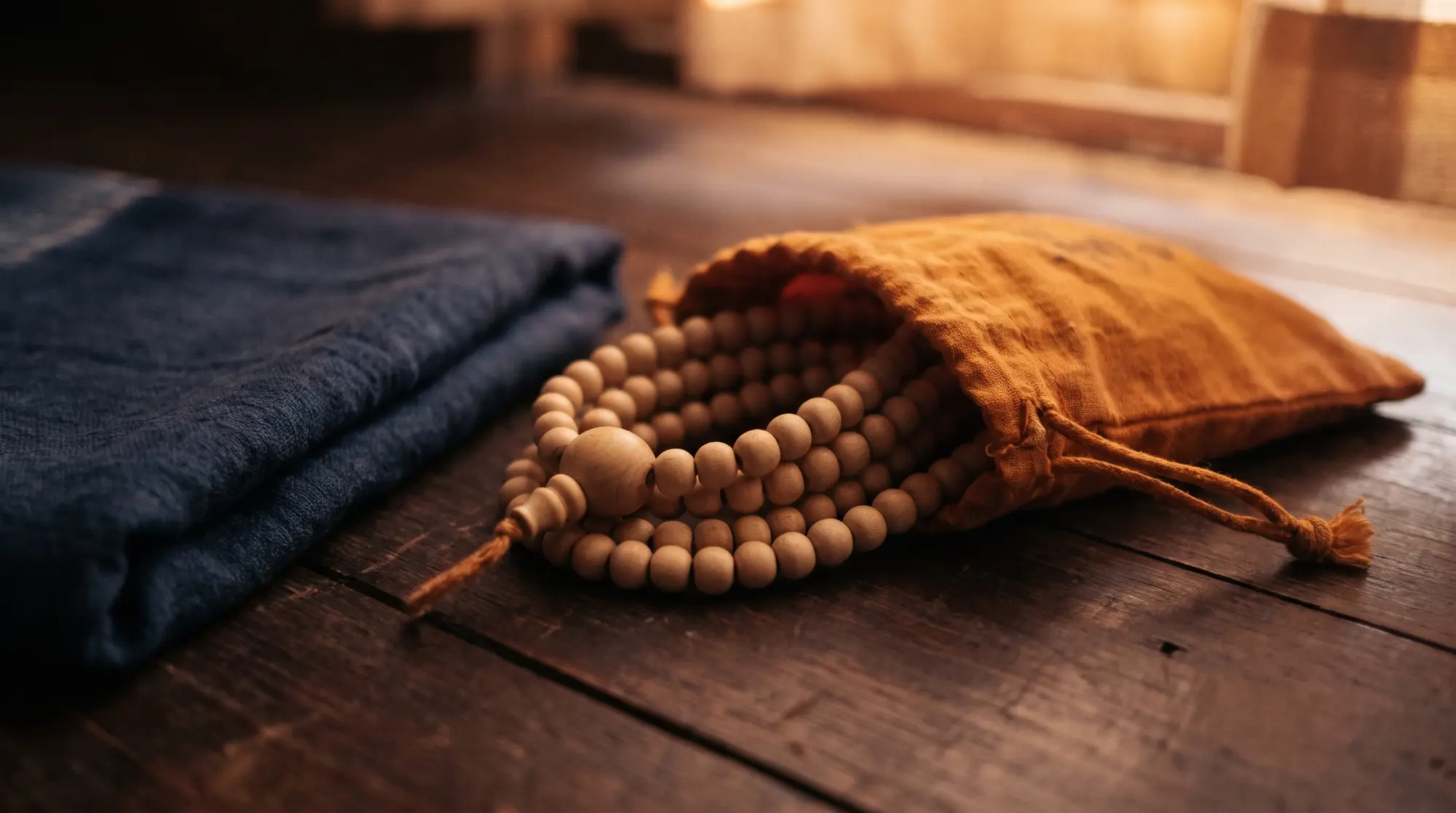
For many devotees, the mala is the most personal object they own. It travels with them for years. It goes to hospitals and weddings, on long journeys and quiet mornings. Some are given by a teacher at initiation. Some were a parent’s, and are worn smooth by two lifetimes of chanting.
The mala is a helper. But it is also something more. It is a small circle of devotion that we hold in our hands.
Tulsi and rudraksha
Vaishnavas traditionally chant on beads of tulsi wood. Tulsi, the holy basil, is dear to the Lord, and devotees honour her as a great devotee herself. To chant on tulsi beads is to chant in her company.
Devotees of Lord Shiva often chant on rudraksha, the seed of a tree long associated with him. Other traditions use sandalwood, lotus seed, crystal or simple wood. Each lineage has its customs, and it is good to follow the guidance of your own teachers.
Whatever the material, the beads are treated with respect. Many keep the mala in a cloth bag, both to protect it and to keep it clean. Many do not let it touch the floor, and do not take it into the bathroom.
A small circle of devotion that we hold in our hands.
A hundred and eight, and one more
A full mala usually has one hundred and eight beads, plus one larger bead, often called the head bead or sumeru, or in Vaishnava communities simply the Krishna bead. It marks the beginning and the end of each round.
The head bead is not chanted on. In many traditions, when you reach it, you do not cross over it. You turn the mala around and go back the way you came. Teachers give different reasons for this: that the head bead represents the Lord or the guru, and one does not step over them; or simply that it marks a pause, a small moment to remember why we are chanting before beginning again.
Whatever the reason given, the turning is a lovely moment. A breath. A chance to begin the next round fresh.
Which fingers
Customs differ, and your own teachers’ guidance comes first. But many Vaishnavas are taught to hold the mala in the right hand, letting it rest over the middle finger, and to move each bead with the thumb. The index finger is usually kept away from the beads. Some say this is because the index finger is the finger of pointing and accusation, and so is set aside from prayer.
Many devotees keep the hand in a bead bag while chanting, with the index finger poking out through a small hole. This keeps the mala clean, keeps the beads private, and frees the eyes from watching the hand.
If your hands are stiff or painful with age, be gentle with yourself. The Lord is not checking which finger you use. Find a way that lets you chant with ease.
The Lord is not checking which finger you use.
When the string breaks
Malas wear out. Strings fray, and one day a string may break and the beads scatter. Devotees often take this calmly, even lovingly, as a sign of years of chanting. The beads are gathered with care and restrung, or the old mala is retired respectfully, sometimes placed on the altar or in a holy river.
Some devotees keep an old mala long after they stop chanting on it. It holds memories of many mornings.
The beads and the heart
The beads are a great help. They carry the count so the mind need not. They give the hands something to do, which quiets restless bodies. Their touch reminds us, bead by bead, that we are in the Lord’s service.
But the saints remind us that the beads are not the point. The point is the Name, and the heart turning toward the Lord. A mala in the hand and a wandering mind is still an incomplete prayer. A mala in the hand and a listening heart is complete, whatever the count.