
People are often unsure how loudly they should chant. Should the voice be clear and audible? A soft whisper? Or entirely silent, in the mind alone?
The traditions answer in different ways, and each answer holds something precious. There is no single right volume. There is only what helps you hear the Name.
A lamp on the threshold
Tulsidas gave a lovely image for chanting with the voice.
राम नाम मनिदीप धरु जीह देहरीं द्वार ।तुलसी भीतर बाहेरहुँ जौं चाहसि उजिआर ॥
rāma nāma manidīpa dharu jīha deharīṁ dvāratulasī bhītara bāherahuṁ jauṁ cāhasi ujiāra
Place the jewel-lamp of Rama’s Name on the threshold of your tongue, says Tulsi, if you want light both within and without.
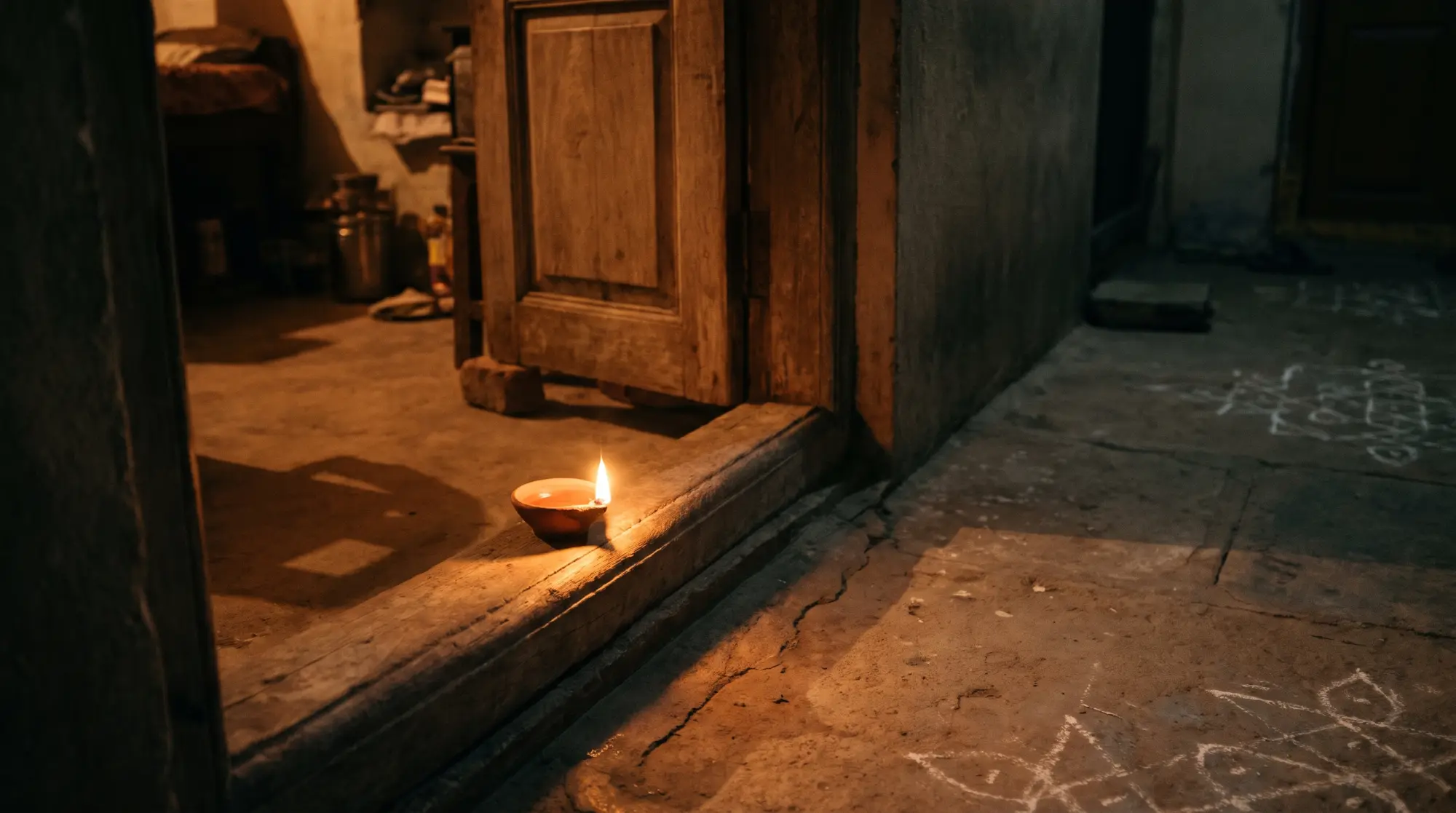
In Indian homes, a lamp is often placed on the doorstep at dusk. Its light falls both ways: into the house and out into the courtyard. Tulsidas says the tongue is that doorstep. When the Name rests there, it lights the inner world and the outer one at the same time.
The tongue is the doorstep. The Name is the lamp.
Chanting aloud
Many Vaishnava teachers encourage chanting japa audibly, at least softly enough that we can hear ourselves. The reason is simple: hearing is the heart of the practice. When the Name is spoken, the ears can catch it. The voice also helps keep the mind from drifting into silent daydream.
Chanting aloud does not mean chanting loudly. A clear, gentle voice, the volume of speaking to someone sitting beside you, is enough.
The whisper
Some traditions value the softly murmured mantra, heard by oneself alone. A whisper draws us inward. We must lean in to hear it. Many devotees find that whispering at dawn, when the house is still asleep, has a special intimacy.
A whisper is also kind to others. In a hospital room, a shared bedroom, or a train, it lets us chant without disturbing anyone.
Silent chanting
Chanting in the mind is honoured in many traditions as subtle and deep. It is also a great mercy for times when speaking is impossible: in illness, when the voice is weak, in a crowded place, or at night beside someone sleeping.
The challenge of silent chanting is that the mind can slip away more easily. Without the anchor of sound, it is easy to drift. Many find it helps to move the lips a little, even without sound. It keeps the Name more present.
Finding your own voice
How do you know which way suits you? Try each for a week, and watch honestly. Which one keeps you awake? Which one helps you hear? Which one feels most like speaking to the Lord rather than reciting?
Many devotees find the answer changes with the hour and the season. Aloud in the early morning, to stay awake. A whisper in the afternoon, when others are near. Silent at night, lying in bed, with the beads resting on the chest. Follow the guidance of your own teachers first. Within that, let the voice serve the hearing.
And whatever the volume, let each Name be whole. A soft Name, fully formed, is better than a loud one rushed and swallowed.
A soft Name, fully formed, is better than a loud one rushed and swallowed.
There is no single right volume. There is only what helps you hear the Name.
Chanting together
There is another kind of chanting that is not about volume at all, but company. Krishna describes devotees who find joy in speaking of Him together.
मच्चित्ता मद्गतप्राणा बोधयन्तः परस्परम् ।कथयन्तश्च मां नित्यं तुष्यन्ति च रमन्ति च ॥
mac-cittā mad-gata-prāṇābodhayantaḥ parasparamkathayantaś ca māṁ nityaṁtuṣyanti ca ramanti ca
Their minds on Me, their lives given to Me, they enlighten one another and speak of Me always, and in this they find contentment and joy.
Chanting japa in a room with other devotees, each on their own beads, has a special atmosphere. The quiet sound of many voices is like a river. When your own attention fades, the others carry you. When theirs fades, you carry them, without anyone saying a word.
Yet solitude has its gifts too. Alone, there is no one to compare ourselves with, and nothing to perform. Many devotees keep both: most rounds alone in the quiet of home, and some, when possible, in the company of others.